Project & Infrastructure terms
Public‑Private Partnership (PPP)
A Public‑Private Partnership (PPP) is generally understood as a long‑term contract between a government entity and a private‑sector partner to provide a public asset or service, with significant risk and management responsibility transferred to the private party, and remuneration linked to performance. [29]
DB(F)M
A DB(F)M contract is an integrated contractual arrangement in which the execution of several components of an infrastructure project is entrusted to a single private partner, the private contractor. Under a DB(F)M agreement, the private contractor assumes responsibility for virtually all operational aspects of the infrastructure project: Design, Build, (Finance), and Maintain. [30]
O&M phase
The operational & maintenance (O&M) phase is the long‑term operational period during which the completed infrastructure is kept in service, with the project company responsible for inspections, preventive maintenance, corrective repairs, performance monitoring, and ensuring the asset meets contractual service levels.
This phase begins once the asset has passed testing, commissioning, and formal handover. [31]
Resilient infrastructure
Resilient infrastructure refers to infrastructure systems that are designed, built, and managed to withstand, absorb, recover from, and adapt to a wide range of shocks and stresses, including natural hazards, climate‑related events, technological failures, and cascading disruptions. [11]
Critical Infrastructures
The Critical Infrastructures are physical structures, facilities, networks and other assets which provide services that are essential to the social and economic functioning of a community or society. [32]
Asset Vulnerability
The Asset Vulnerability are the conditions determined by physical, social, economic and environmental factors or processes which increase the susceptibility of an individual, a community, assets or systems to the impacts of hazards. [32]
Performance‑based design
Performance‑based design is founded on the premise that structural systems must meet specific performance objectives. Specific performance expectations are set for the completed design… The design is completed by demonstrating complying performance through analysis, simulation, testing, or a combination thereof. [33]
Natural hazards & Climate-Related terms
Hazard
Hazard = A process, phenomenon or human activity that may cause loss of life, injury or other health impacts, property damage, social and economic disruption or environmental degradation. [32]
Vulnerability
Vulnerability = The conditions determined by physical, social, economic and environmental factors or processes which increase the susceptibility of an individual, a community, assets or systems to the impacts of hazards. [32]
Disaster Risk
Disaster Risk = The potential loss of life, injury, or destroyed or damaged assets which could occur to a system, society or a community in a specific period of time, determined probabilistically as a function of hazard, exposure, vulnerability and capacity. [32]
Natural Hazards
The Natural Hazards are predominantly associated with natural processes and phenomena. To be opposed with Anthropogenic Hazards, or human-induced hazards, are induced entirely or predominantly by human activities and choices. [32]
Climate proofing
Climate proofing is the process through which projects are screened, assessed, and adjusted to ensure their resilience to future climate conditions and their consistency with EU climate objectives, including the reduction of greenhouse‑gas emissions and alignment with the Paris Agreement. [47]
Triggering Process
The Triggering Process is an event or process that initiates or activates a hazardous phenomenon or disaster event. For example an intense rainfall triggering landslides, heatwaves triggering wildfires and glacier collapse triggering debris flow.
Compound Hazard
The Compound Hazard is the combination of multiple drivers and/or hazards that contributes to societal or environmental risk. Like storm + heavy rainfall.
Secondary Hazard
The Secondary Hazard is a hazard that occurs as a consequence of another hazard or disaster event. Like floods causing contamination.
Earthquakes
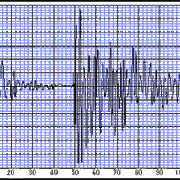
A term used to describe both sudden slip on a fault AND the ground shaking that occurs from the radiated seismic energy during the slipping event. The sudden slip can be caused by stress changes in the earth or volcanic/magmatic activity. [36]
Fault
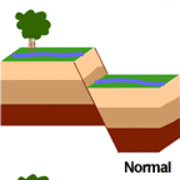
A fracture along which the blocks of crust on either side have moved relative to one another parallel to the fracture. [36]
Liquefaction
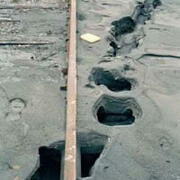
A process by which water-saturated sediment temporarily loses strength and acts as a fluid, like when you wiggle your toes in the wet sand near the water at the beach. This effect can be caused by earthquake shaking. [36]
Landslide
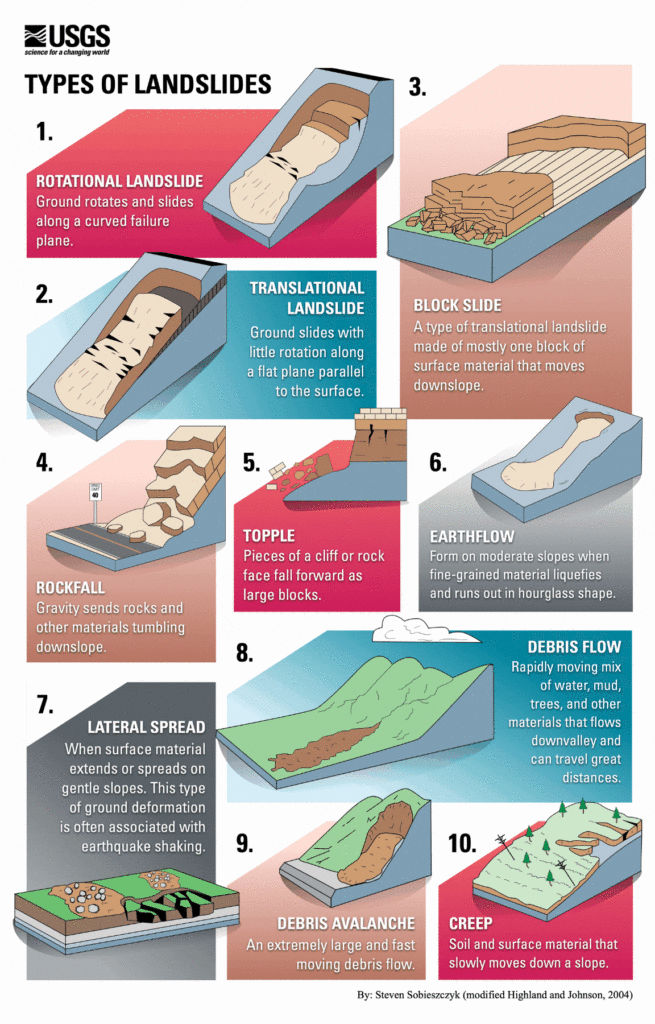
The movement of a mass of rock, debris, or earth down a slope. Earthquake shaking and other factors can also induce landslides underwater. These landslides are called submarine landslides. Submarine landslides sometimes cause tsunamis that damage coastal areas. [36]
Rockfalls
Rockfalls are abrupt movements of masses of geologic materials, such as rocks and boulders, which become detached from steep slopes or cliffs. Separation occurs along discontinuities such as fractures, joints, and bedding planes, and movement occurs by free-fall, bouncing, and rolling. Falls are strongly influenced by gravity, mechanical weathering, and the presence of interstitial water. [36]
Debris Flow
A debris flow is a form of rapid mass movement in which a combination of loose soil, rock, organic matter, air, and water mobilizes as a slurry that flows downslope. Debris flows include <50% fines. Debris flows are commonly caused by intense surface-water flow, due to heavy precipitation or rapid snowmelt, which erodes and mobilizes loose soil or rock on steep slopes. Debris flows also commonly mobilize from other types of landslides that occur on steep slopes, are nearly saturated, and consist of a large proportion of silt- and sand-sized material. Debris-flow source areas are often associated with steep gullies, and debris-flow deposits are usually indicated by the presence of debris fans at the mouths of gullies. Fires that denude slopes of vegetation intensify the susceptibility of slopes to debris flows. [36]
Debris Avalanche
This is a variety of very rapid to extremely rapid debris flow. [36]
Rock-Ice Avalanches
Rock-ice avalanches are defined as rock and debris avalanches that involve ice, firn, or snow from initiation by the failure of high-mountain rock-ice walls, steep glaciers, or the entrainment of ice along their propagation paths. [37]
Sinkhole
A sinkhole is a depression in the ground that has no natural external surface drainage. Basically, this means that when it rains, all of the water stays inside the sinkhole and typically drains into the subsurface. Sinkholes are most common in what geologists call, “karst terrain.” These are regions where the types of rock below the land surface can naturally be dissolved by groundwater circulating through them. Soluble rocks include salt beds and domes, gypsum, limestone and other carbonate rock. [36]
Flash Flood
A flash flood is a flood of short duration with a relatively high peak discharge. [32]
Storm Surge
A storm surge is an abnormal rise of water generated by a storm, over and above the predicted astronomical tide. [38]
River Scour
The removal of sediment or engineered materials from the bed or banks of a watercourse is known as ‘river scour’ and can occur when the forces imposed by the flow on a sediment particle exceed the stabilising forces. [39]
Glacial Lake Outburst Flood
A Glacial Lake Outburst Flood (GLOF) is a sudden discharge of a large volume of water from a glacier- or moraine-dammed lake.
Snow Avalanche
A snow avalanche is a mass of snow, often mixed with ice and debris, moving rapidly downslope under the influence of gravity.
Ice Avalanche
An ice avalanche is the rapid downslope movement of a mass of ice resulting from the collapse of a glacier, glacier tongue, hanging glacier, serac, or ice-covered slope.
Ice Avalanche
An ice avalanche is the rapid downslope movement of a mass of ice resulting from the collapse of a glacier, glacier tongue, hanging glacier, serac, or ice-covered slope.
Permafrost Degradation
Permafrost degradation is the warming, thawing, and loss of perennially frozen ground, resulting in a reduction of the extent, thickness, or ice content of permafrost.
Clay Shrinkage
Clay shrinkage is the decrease in volume of a clay soil resulting from loss of water from its pore spaces and adsorbed water layers.
Soil Swelling
Soil swelling is the increase in volume of a soil mass caused by the absorption of water.
Subsidence
Subsidence is the downward movement of the Earth’s surface relative to a datum such as mean sea level.
Risk Management & Insurance terms
Resilience Measures
Actions aimed at strengthening the capacity of a system to resist, absorb, recover from and adapt to climate-related or natural shocks. [32]
Adaptation Measures
Adjustments in natural or human systems in response to actual or anticipated climate stimuli, aimed at reducing or mitigating their adverse effects. [34]
Exposure
Determines the magnitude of potential cost impacts from climate hazards on infrastructure systems. [36]
Insurance Coverage
The range of risks, perils and insured amounts covered by an insurance policy.
Risk Premium
An additional financial cost required by investors or insurers to compensate for a higher level of risk.
Provision Buyback
A contractual mechanism allowing the private partner to buy back a provision or a risk initially allocated to another party, generally in exchange for a payment or a contract revision.
Re-baselining
The process of revising a project’s schedule, budget or baseline assumptions when the initial conditions are no longer valid (e.g. due to climate change, inflation or emerging risks).
Risk Allocation
The distribution of risks between the parties to a contract (public and private) according to their respective ability to manage them at the lowest cost.
Force Majeure
An unforeseeable, irresistible and external event preventing the performance of a contract (e.g. earthquake, war or natural disaster).
Contingency Fund
A financial reserve intended to cover unforeseen costs related to identified or unidentified risks.
Lifecycle Reserve
A fund dedicated to future maintenance, renewal or repair costs of an asset throughout its lifecycle.